Showing posts with label photos. Show all posts

05 April 2010

Beersheva

Pesach Break served as a time to travel, since I don't really have any other chances to do it before I leave Israel. I've already posted about my trip to Tzfat; my second trip was only a day trip, but in some ways it seemed even bigger.

I wanted to go to Beersheva for what seemed like the coolest shuk in the entire country:
On the south side of Beersheba, in Elat Road (Derekh Elat), the Bedouin market is held every Thursday. It is frequented by Bedouin from far and wide, and its colorful bustle of activity attracts many tourists. The main wares of interest to visitors are carpets, finely embroidered cushions and camel saddles, copperware and numerous other craft products; the local people, on the other hand, come to buy articles of clothing, domestic requisites, skins and also live goats and hens. (from this site)
Other descriptions mention the sale of camels and sheep, which I just think is cool. I mean, it's not like I'm going to buy a camel and bring him home with me, but I've never seen a place where they're sold before. There's also a place near Beersheva where you can ride camels, so it seemed like the ideal trip--that is, until my usual travel luck took over.

Lynley and I got up early on Thursday, ate some matzah for breakfast, and headed to the Central Bus Station for the hour and a half ride to Beersheva. We made it there by 10 and walked to where the Bedouin Market was supposed to be, only there wasn't really a market. Instead there was this city festival thing with exhibitions, food vendors, music, and kids' crafts, which wasn't quite what we'd come to see (and also not particularly up and running at 10:30am). There was one Bedouin guy who set up shop--a tent and a bunch of stuff spread out--but that was it.
(Photo courtesy of Lynley)

One tip about Bedouin markets: never ask the price of something that you have no intention of purchasing. Curiosity may not kill you, but it will sic a very persistent salesperson on you who won't leave you alone until you either buy something or walk away--and in my case walking away wasn't an option, as Lynley was partaking in some hooka and pretending to be a dragon:

Actually, smoking hooka in a Bedouin tent might not be such a good idea either. Bedouin salespeople can be very creepy. The same guy who pushed me to buy also insisted on sitting down next to us and attempting to persuade Lynley to marry him for a full five minutes, or until we left--and I'm pretty sure he was serious.
Apparently Lynley has "magical eyes," though he'd used that line on me not five minutes before as a bargaining tool. (Bedouin markets also mean haggling. Bigtime. I paid 1/3 of the originally offered price for what I bought, and I still think I was probably ripped off.)

After we left the Bedouin Market--what there was of it--we headed down to the Beersheva Visitor's Center, which is located near Abraham's Well. This is where we discovered that Beersheva really isn't a tourist place. The visitor's center was just a small room with a few pamphlets, all in Hebrew except for one random pamphlet in French. The only English in the entire place was a misspelled sign next to Abraham's Well, which you have to pay 5NIS to see:

In actuality that's not really Abraham's well but rather a Turkish one, and there are no signs of explanation anywhere other than the Biblical verses. How was the well discovered? When? What's the wooden thing for and how does it work? No explanations anywhere. A bit disappointing.

After visiting the really unhelpful visitor's center we headed for lunch in the old city. Beersheva is supposed to be "the heart of the Negev," and if Beersheva is the heart of the Negev, the old city should reasonably be the heart of the heart--which is the case in both Jerusalem and Tzfat, the other Israeli cities I know that have old cities. Wrong! The old city of Beersheva was like a ghost town. Most of the restaurants were closed for Pesach, the buildings were run-down and graffitied, and the only people we saw were a few blue-collar workers, one of whom seemed to be chasing after us screaming but was really trying to get the attention of someone in a car. It was really sketchy, and we abandoned it for the mall food court very quickly.

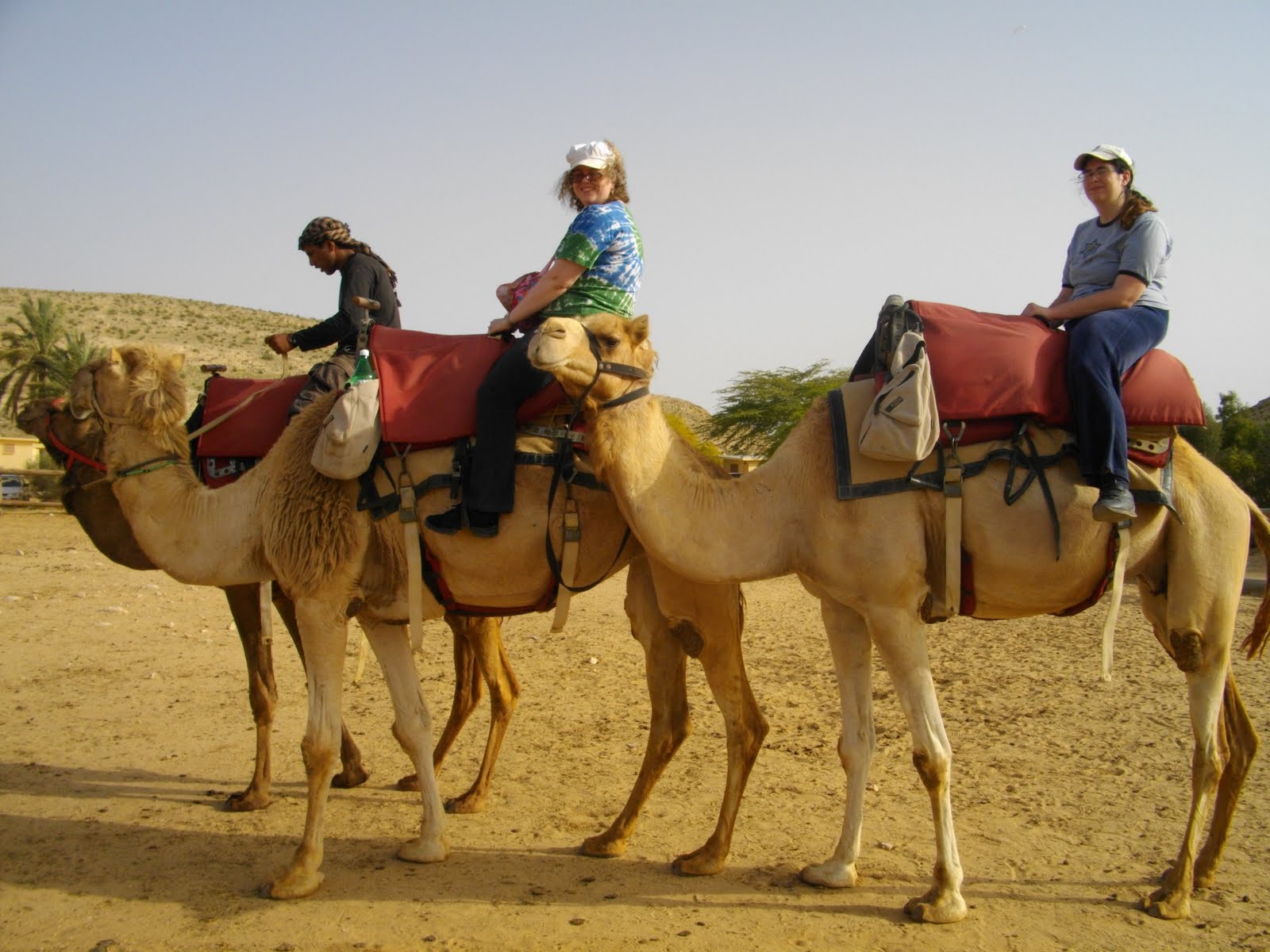
After lunch we set out for the Negev Camel Ranch, or in other words, Cameland. I always love it when the bus drops you off by the side of the road in the middle of nowhere, but luckily there was a map on the Camel Ranch website that I'd copied down and a nice big sign once we'd walked 100 meters down the road. Of course, from there it was a loooooong walk to the ranch because this is Israel, and this is the desert. But when we reached it--there were camels! Lots of camels! And these pictures are only the ones they don't take out on rides for tourists!

After waiting for about an hour--the day was full of waiting, since we were also crowded out of our first bus for Cameland--we ended up with a private camel tour just for the two of us. This is where I learned that camels are really slow and desert looks like desert looks like desert. However, I definitely got to ride a camel. That was completely worth the trip.

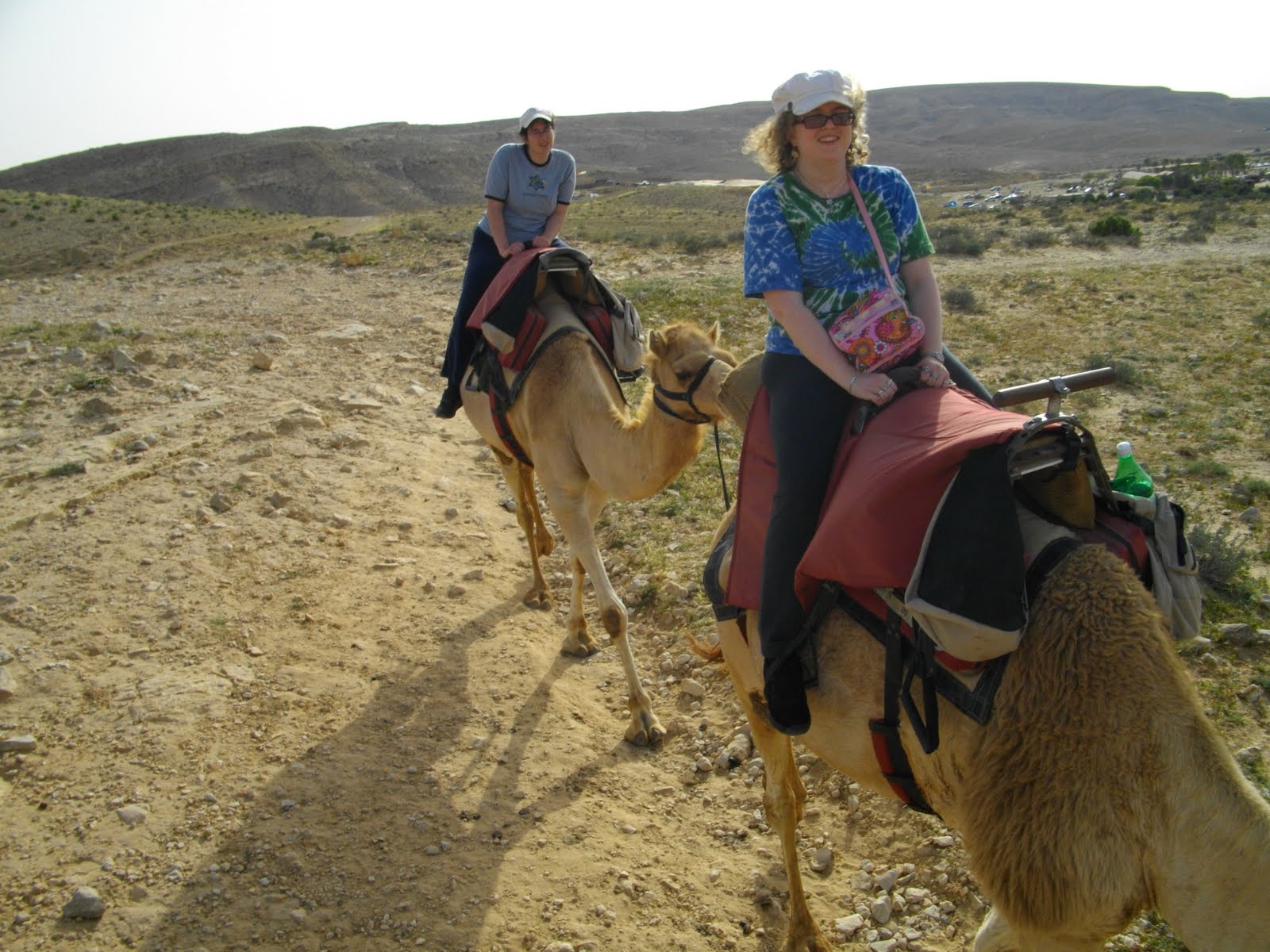
After riding camels it was time to go back to Jerusalem, since it was already 5pm. Of course, as I mentioned earlier, our bus stop was out in the middle of nowhere, on the side of the road, without any signs whatsoever:
Also, the bus back to Beersheva only runs every hour and a half. This left Lynley and me by the side of the road for an hour, watching cars go by. We weren't necessarily trying to hitchhike back, but we wouldn't have minded it, and it's funny what drivers do when they see people standing by the side of the road. We got a lot of people putting their hands up like "What am I supposed to do?" and some people honking at us. The entire time we didn't even see a taxi pass and the bus was 20 minutes late, so we had this plan of walking to Dimona--the nearest town, about 5 minutes drive away--if the bus didn't show. While the bus did finally show, it was only after a car pulled over and a really nice couple offered to give us a lift to Beersheva. We took it. It sure beat walking to Dimona. From Beersheva it was an easy ride back to Jerusalem and the Kfar, though I didn't get back until after 9pm. Then it was pretty much bedtime. Tourism is exhausting, especially when it involves hour-long camel rides.

Pesach in Israel

Absolutely the best part about Passover in Israel is the fact that it's only 7 days long, rather than the 8 days in the rest of the world. Seriously, it's amazing. My diet this past week has consisted of mainly 4 things: matzo pizza, matzo with peanut butter, mashed potatoes and corn, and matzo ball soup. It gets old.

That said, there's so much more difference between Pesach in Israel and in the US. For one, you really can't get chametz anywhere. Maybe in the Arab neighborhoods you could, but at least in the Jewish parts the supermarkets look sort of like this:
And by that I mean that they're all covered up. Most shelves still have all the non-Pesach food on them (you just can't get to it), but in the case of fresh bread everything's just gone. Ahuva's standing there with the last loaf of bread in the entire store and it was only Sunday--Pesach didn't start until Monday night.

And then there's restaurants. A lot of restaurants just close down for Pesach, but plenty stay open and even have pretty much their normal fare. I was very confused on Thursday when I entered the Central Bus Station and saw what I thought was the normal sandwiches (below), but then when I went back to take a picture I noticed that there was a sign saying that everything was kosher for Pesach (also below). You do not find this kind of thing in the States.
That's not all there is, though. Most places have a lot of salads, but there's also realistic looking pizza and quiches and breaded fish and... everything. Pretty nearly everything, not to mention the potatoes and other things that are always kosher for Passover. My roommate says these things are made mostly out of potato flour and that they actually taste good, but I didn't try most of them. My eating out consisted of a bad potato boureka in Beersheva on Thursday and a potato and spinich "blintz" (really an omelet) and Passover cheesecake at Village Green yesterday. The cheesecake looked good enough (see below), but it had this awful almond macaroon bottom and really wasn't worth the 31NIS I paid for it--typical of Village Green desserts, but I do it over and over again anyway. Besides--cheesecake is one of those pleasures you need to have during such an awful food holiday. (I just miss it being free and made by my father.)
(Picture courtesy of Lynley.)

So maybe Israel is the best place to be for Passover if you're willing and able to eat out all the time, but otherwise I'm actually not so fond. Where are the tins of macaroons? Where's the (mostly) really bad mixes for pancakes and muffins and cakes and things? For that matter, where's the matzo farfel? I'm not one to eat out all the time, and I honestly missed some of the things that you can get in the States during Pesach. There's this one really good apple cinnamon muffin mix that you can get in the States, I think Savion brand, in a brown box that's amazing and definitely not Manischewitz, I miss that a lot. I usually live off muffins during Pesach, but that hasn't happened this year. Call me crazy, but I think I'd actually rather spend Passover in the States--even with the extra day. I'll trade an extra day for some muffins, thank you very much.

28 March 2010

Tzfat

I spent this past weekend in Tzfat, one of the four holy cities (the others being Jerusalem, Hebron, and Tiberias). I was there once before, in high school, and I remembered it being beautiful. As someone who goes to Friday night services pretty regularly, I love thinking about the fact that this is where Lecha Dodi was written, and really Kabbalat Shabbat as a whole was formed. The city has a lot of spiritual meaning.

The trip started out on Thursday by discovering that the 982 bus to Tzfat doesn’t actually leave from the Central Bus Station, even though that’s where you buy your tickets. Also, the big “23” on the ticket dosen’t mean “gate 23” but rather a zone. So… Lynley and I missed our bus and had to wait two and a half hours for the next one. Yay. At least I finally got to check out the mall that’s in the Cental Bus Station, and obtained something that you’ll probably only find in Israel—haggadot in a dollar store.

We finally made it to Tzfat around 7pm after a three and a half hour bus ride up and down and around lots of mountains. (It’s Israel.) Guidebooks tend to only spend a page on Tzfat as part of the section on the Galilee, so we got off the bus and had to wander around until we found a sign for our hostel, Ascent. “Go up the stairs and follow the map,” it said—what map? There was no map! Thankfully I remembered that someone at the office had called my phone to confirm our reservation, so the number was in my phone and I was able to call them for directions.

The thing about Tzfat is… even with a map, you get lost. It’s one of those places that maps can’t really handle, like the Old City of Jerusalem. For example, this:

That’s a road. There’s no signs and no stores or houses on it to indicate that it’s a road, no street numbers, but it’s very definitely marked on the map as Ma’alot Olei HaCardom. Such is Tzfat.

The first place we tried to go for dinner, Café Bagdad, kicked us out saying that they were only serving coffee, even though they were open for another half hour. (This was 8:30pm.) So we went to the next place the people at Ascent recommended, Café Milano. There we discovered that even though Tzfat is mainly known for kabbalah and art, there’s actually another piece to it: cheese. According to the faulty map there was entirely a whole cheese museum! (In actuality, no such place exists.) Anyway, this meant that there were a lot of cheese dishes at Café Milano. Lynley ended up getting something called “halumi salad,” which was actually pasta in teriyaki sauce with cashews, bell peppers, and halumi cheese. I got a cheese platter with roasted vegetables. Lynley very much got the better deal; her halumi salad was amazing. (I know cause I got to try some.) Take a look:

My cheese platter was okay. I really liked the labane, but of the other two cheeses one was okay and the other I didn’t really like. The veggies were also okay, not wonderful. But Lynley’s halumi salad… wow! Amazing. Just amazing.

After dinner we headed back to Ascent and went to bed. Then on Friday we woke up early and went to explore Tzfat before everything closed for Shabbat. Our first stop was Safed Candle Factory, where they really make art out of candles. Like, for example, the Temple:

or a whole bunch of penguins:

There was also one of David and Goliath and one of Samson tearing down the Philistine temple, but I wasn’t so interested in those. While we were there we also eavesdropped on a tour guide teaching a family a bit about how regular havdallah candles are made, basically by dipping string into melted wax multiple times and then weaving the tapers together while they’re still hot. It’s pretty cool. I actually spent as much money at the candle factory as I did for two nights at Ascent, which either says something about how cheap Ascent is or how impressive the candle factory is. Maybe both. And no, I did not buy a penguin—their faces were too weird.

From the candle factory we poked our heads into the Ari Synagogue (looks like a normal Orthodox synagogue, minus the women’s section) and proceeded to a street lined entirely with galleries of more conventional art—paintings, jewelry, and Judaica. There were some really beautiful things there, all of it expensive. There was even one shop where we got to watch weavers at work, which was really cool although I don’t understand why anyone would spend more than $100 on a really plain-looking matzah cover.

And of course we had to go find the cheese. There are signs all over the place saying “Tzfat cheese à” or “holy Tzfat cheese à” all of which led to another and then yet another sign. Reaching the cheese factory is like going thorough a maze, literally. When we get there it was just a little place—a table covered with different cheeses, a few tables for sitting down, and a room with vats in it that are used to make the cheese. Unfortunately we didn’t get to find out how cheese is made (we’d have to come back on Sunday for that, except that we were leaving Tzfat on Saturday night), but we did get to try every single one of his cheeses. They weren’t expensive, either; I got small pieces of feta and the special Tzfat cheese for only $10. That plus the four rugalach I’d brought from Jerusalem were more than enough for lunch.

Cheese:

So Friday was good. Shabbat… not so much. It’s odd because when I said I wanted to spend a Shabbat in Tzfat, I was warned that Ascent was really, really Orthodox—which is true. However, I’ve spent Shabbat with the Orthodox before, and as long as I know I’m there for Shabbat and not for a long period of time, I even sorta enjoy parts of it. Organizations that reach out to non-Orthodox students tend to be really concerned about how you’re doing and completely willing to talk to you about Orthodoxy. They have this kind of excitement to them. The people at Ascent… didn’t really. There was a shiur before Shabbat, but it didn’t really go anywhere. After that was supposed to be “Candlelighting and orientation,” but in reality it was just lighting on our own and sitting around until time to go to services. Dinner wasn’t with families in Tzfat, as it usually is at Ascent, but all together in a room in the hostel with not so wonderful food. Saturday was more of the same, if not worse; downtime until lunch unless you got up in time to go to 8am services at a synagogue of your choosing, a meal in which there was no vegetarian option (brisket and potatoes that were cooked together with the brisket), more down time until 4:45, an hour-long tour of Tzfat, and then more down time until dinner and even more downtime until havdallah!

Honestly, if I wanted to stay in my room and read and eat crappy found, I could have stayed in Jerusalem. I wasn’t too pleased with Ascent Shabbat. Usually they pay attention to us. Usually there’s singing and words of Torah and decent food when Orthodox organizations try to draw people in (and presumably the rest of the year, too), and that’s what I was expecting. That’s what I paid for. I feel like it would have been different if we’d gone to families for meals, but the website made no mention of the fact that Shabbat HaGadol isn’t a Shabbat where we get hosted. If it had, we probably would have come another weekend.

It all just seems very odd to me. They asked us twice if we were vegetarian—once on the registration form, and once when they called to confirm our registration. There was at least one other girl in our boat, too. If you know more than 48 hours in advance that 3 out of your 10 English-speaking guests are vegetarians, how in the world do you justify ignoring it? Apparently they expected us to just eat the salads, with no warning that we wouldn’t be able to eat the main dish. Thank you very much for your consideration. I really appreciate it.

I think, in the end, I’m still glad I went to Tzfat for Shabbat. As much of a let-down as it was, as much as it was so not worth the 200NIS we paid for it, if I hadn’t done it I would have wished I had. I would have just continued to have this fantasy of Shabbat in Tzfat and regretted never experiencing it. And there were some good parts to it. I discovered that while no one drives on Yom Kippur, the Shabbat of Shabbats, in Jerusalem, no one drives on Shabbat in Tzfat, period. Not a car moving that I could see, at least not on HaAri Street or Jerusalem Street, the only two streets we walked on where cars can actually go. I also discovered that there are basically no cats it Tzfat. The entire time we were there, we only saw two—as opposed to the rest of Israel, where they’re everywhere. These things are interesting to me. They’re unique, the same way the history is unique. I just wish all of Shabbat was like that.

22 March 2010

Architecture mixed with a bit of politics

Today marked my architecture class's second trip to the Old City, and the last trip for a while. For the most part it was nothing remarkable--just a tour through a Herodian mansion and a visit to the Southern Wall of the Temple Mount. However, current events dictated that we must try to take a look at the newly rebuilt Hurva Synagogue, which we did.

Long story short: the Hurva Synagogue was originally built in the 1860s and was destroyed twice. In 2002 the Israeli government decided to rebuild the synagogue, and it was rededicated last Monday night. This was part of what lead to the "Day of Rage" riots among the Palestinians last Tuesday. The New York Times explains why they're so upset:

The synagogue’s new white dome blends in with the city’s ancient monuments holy to Christians, Muslims and Jews. Because of the topography, seen from certain points around the city, it rises above the Islamic shrines of the compound revered by Muslims as the Noble Sanctuary, and by Jews as the Temple Mount, including Al Aksa Mosque.

In Damascus, Khaled Meshal, the exiled leader of the Islamic militant group Hamas, said the synagogue’s dedication signified “the destruction of the Al Aksa Mosque and the building of the temple,” according to Agence France-Presse.

Okay, so that sounds a little bit drastic. Really, the rebuilding of one synagogue is going to lead to the destruction of the Temple Mount as we know it? However, take a look at this (also mentioned by Ha'arez):
According to a centuries-old rabbinical prophecy that appears to be coming true, on March 16, 2010, Israel will begin construction of the Third Temple in Jerusalem. During the 18th century, the Vilna Gaon, a respected rabbinical authority, prophesied that the Hurva Synagogue in Jerusalem, which was built during his day, would be destroyed and rebuilt twice, and that when the Hurva was completed for the third time, construction on the Third Temple would begin.
And the Third Temple will logically be built on the Temple Mount, and thus Al-Aksa Mosque will be destroyed... it makes sense. Except for the whole "we're going to build the Third Temple now!" part. I don't see the moshiach anywhere; do you? Besides--according to Ahuva's recent sermon, we weren't meant to resume the whole animal sacrifice thing anyway.

Anyway! The brand-new rebuilt synagogue is entirely locked, but we got to go in and see it anyway. See, our teacher is Israeli, and Israelis are pushy and tend to get their way when they're only up against a couple of custodians who answered a classmate's very insistent knock at the door. The synagogue is beautiful. Take a look:


The outside photo is not mine because silly me expected to be able to find a recent photograph online, but apparently not. They're being very secretive about this place, probably because of all the riots and such. But really--how hard is it to take a picture of the outside?

I don't know what to think about the controversy surrounding this synagogue. Sometimes it seems like people--Palestinians and (particularly haredi) Israelis--will riot over just about anything, given the chance. It's not like we're in a position to build the Third Temple, no matter what the Vilna Gaon said all those years ago. Yet--the fact that the dome rises above everything else does make a certain political statement. I read it somewhere--"We're here to stay," it says. The Israelis are here to stay, in the heart of the Old City, in the heart of East Jerusalem, in the heart of Eretz Yisrael... can you blame them for being upset?

15 March 2010

A trip to the City of David

An update about the start of the new semester and my class schedule will come soon; we're three weeks into the semester and my schedule just got finalized today. However, this semester promises many more class-sponsored tourism than I got last semester due to one class: Jerusalem's Architectural History. We had our first field trip today, a visit to the City of David. Possible little known fact: the Old City of Jerusalem today is nowhere near on the same land as the Really Old City of Jerusalem, aka the city that King David built. The only overlap is really the Temple Mount--everything else is outside the current walls.

Another possibly little known fact: Jerusalem architecture is ugly. There's this way of building one house on top of another because that's how you build on the side of a mountain--okay, I get that. But why does everything have to be so blocky? It's just ugly, and it's all over Israel. Really, why? The below photo is of Sirwan, an Arab neighborhood across the valley from the City of David, but it's just one example.


These particular houses obviously weren't there in biblical times, but they were still built one on top of the other--thus how King David saw Batsheva bathing. However, what was there was Warren's Shaft, (probably) the passage through which David and Yoav originally invaded Jeursalem back when it was a Canaanite city. We got to go down there:


Of course, the metal stairs weren't there originally, but it was still pretty cool. We also went through Hezekiah's Tunnel, which involved lots of water and a soaking wet skirt. I couldn't take video in there because I needed my batteries for my flashlight, but I stole someone else's video off Youtube:


This class includes four field trips like this. Today was First Temple Period Jerusalem, next week is Second Temple Period, and in the future we have post-Christianity and Islam Jerusalem and Modern Jerusalem. Pretty cool. Hopefully by the end of the semester things will stop looking like one piece of Jerusalem stone after another... which is really all I can tell of Jerusalem right now.

10 September 2009

Kitty update

Last week was rocky when it came to my cats. On Saturday night I discovered that Mister Zol, the grocery store, doesn't open up after Shabbat, so I had no food for the kitties on Sunday. Sunday night, I discovered that they close at 21:00, and I went at 21:15. On Tuesday I finally had cat food, but my roommate and I got to campus too late for me to do my feeding. On Wednesday someone fed them before I got there, from the looks of it real white meat. I think I finally got to feed them on Thursday.

This week has been better; I haven't posted only because I was waiting to have video. I still haven't figured out how to feed and tape at the same time--the video's sorta awful. The cats were also really spread out this morning, but I think if you count you'll find all twelve.


The cats know me by now. Twice in a row now they've come running, and this morning I didn't even have to sit down first. The kitten's also becoming more trusting; it took a while for him to come out of his bush, and then he would run back into it whenever anyone walked down the path. Now he'll stay there and eat, as long as there's a bigger cat between him and the people. ("Mommy, hide me!")

I haven't named any of them yet, and I doubt that I will. There are some consistent kitties, but otherwise the cats in the humanitiies block change day by day. They also don't trust me enough to let them touch them--with the exception of Naftali, who has been affectionate since way before the feedings. I wonder if they'll ever trust me that much?

Speaking of Naftali, yesterday I found a girl pouring water into a rock for him. She said he was dehydrated; he'd drunk half her bottle already. I'm really glad I saw that; somehow, I've never stopped to think about how these cats get there water. It doesn't rain during the summer in Israel, ever. How do they find water to drink? Anyway, I've started giving them water, too. A container that had held creme cheese is now a kitty water bowl, assuming the people who clean the university don't find it in the bush and throw it away. I think I'll make the same thing out of my butter container when it expires, and the rocks have little grooves which can hold water. It's so simple; why hadn't I thought of it before?

When I got back to Kfar HaStudentim after class, I found Lynley with a couple of kittens, whose names seem to be either Yossi and Charlie or Hariette and Gila depending on who you ask. Yossi's scared of people, but Charlie's the friendliest kitty I've ever seen. As soon as I sat down on the bench she was in my lap, climbing around on top of me and on top of my backpack. I don't have any footage of that--it was so unexpected--but I can show you Charlie/Gila with Lynley, and being otherwise generally friendly!


After Lynley left, a couple of people who work in the office came out with a container of what I think was tuna. It makes me feel cheap to be feeding them dry cat food, but... the cats seem to like it just the same, and it's probably better for them.

Though, I could give Charlie one kind of fish to play with!


01 September 2009

Tour of the tombs

Today Jeff Seidel took sixty of us on a tour of biblical gravesites. Before anyone freaks out, I would like to mention that yes, they are in the West Bank. The areas we went to are also patrolled by the IDF, and we were riding in a bullet-proof bus. Well, the whole bus thing is actually not reassuring at all, but I am happy to say that we were not shot at during our trip. Not that I thought we would be; I don't think the rebbitzen of the center would bring her two-year-old and five-year-old daughters anywhere she thought was the slightest bit unsafe, let alone a busfull of students that they're liable for.

The trip included visits to Rachel's Tomb outside of Bethleham and the Cave of Machpelah (the burial site of Abraham, Isaac and Jacob, Sarah, Rebecca, and Leah) in Chevron. I was surprised by the difference between the two places. Rachel's Tomb is a tiny place, but heavily protected. In the photo below--the view outside the building of the tomb--you can see a large white wall; this wall spirals around and around, so the tomb is entirely protected. The building itself is tiny, intimate. It's like the Kotel in that it's separated into a men's section and a women's section, and people are gathered there praying. It's beautiful, in a classical Judaism sort of way. The video below is one that I took today of the women's side of the tomb.


The Cave of Machpelah is supposed to be holier than Rachel's Tomb - it's second in holiness only to the Kotel - but if anything, it seemed to be more commercialized to me. In Rachel's Tomb I felt compelled to daven, even though I had no siddur with me; I started mincha--what I know of it by heart--and it led to my own prayers, free-form, which I very rarely do. But at Machpelah, even with a siddur, I couldn't concentrate of the prayers. I wasn't compelled to pray; it felt like any other Orthodox synagogue. I felt more connection when I touched the wall near where our ancesters are actually buried (see below) than when I was inside the structure.


There's also an amazing difference in the outsides of the tombs. Rachel's Tomb is heavily protected, but Machpelah is completely out in the open. Note that the sound at the very beginning of the video is the end of the Muslim afternoon prayer; the whole thing played on speakers above our heads.


I think the number of tourists at these sights is particularly telling of the situation in Israel right now. These are extremely holy places, but we didn't see a single other tourist on our trip. There were people there, but they were ordinary Israelis, davening and studying. These places are in the West Bank; tourist groups don't dare go there the way they go to the Kotel or Masadah. Yet, take a look at one last picture:


This is the view of Chevron from the top of the Chevron Yeshiva. If this was just a random picture that I posted, wouldn't you think it was just another shot of Jerusalem?

13 August 2009

Cat food

Today I followed a string of meows and stumbled upon cat feeding ground. There I found a woman surrounded by what seemed like every cat on campus. The woman, I discovered, is a law librarian who took over the feeding while her friend was away. The cats are taken care of after all; my skinny cat even has a name already, Neftali (which is much better than calling her Bone(s)). Even with the food she brought, though, many of the cats didn't get to eat anything, and those who did eat did so by pushing each other out of the way. None of the cats ate much, but I could tell how glad they were to get what they did.

I think that I'm going to buy a box of cat food next time I go to the grocery store. It doesn't cost that much--10 NIS--and maybe it'll make some of these cats trust me a bit more.


10 August 2009

Movement

The first question in a series of yes/no questions on the Hebrew University housing application is "Do you want to live in a shomer Shabbat apartment?" I left the question blank; I am not typically shomer Shabbat, but I wanted to live with other religious students. As a result, the school put me in non-religious housing. My first Shabbat came and went without even feeling like Shabbat. I slept in on Saturday morning and then spent the day on my computer. Friday night meant very little to me--we went to services, but with a minyan which mumbles everything. I know myself. If I'm not with other religious people, I'll ignore everything. There's no reason to do that while I'm living in Jerusalem. So I switched. My new roommates seem nice--a girl from CT named Esti and an Israel whose name I have yet to learn. I like the feeling of sleeping on sheets rather than having a sleeping bag spread over a bed as I had before I moved. The experience will be interesting, I think. Esti said she'd teach me enough about keeping a kosher kitchen that I won't mess up.

My room also has an excellent view. Take a look at this:


(It's even cooler if you click it.)

A move that happened, and another one that didn't. I have a love/hate relationship with ulpan right now. We're doing things that I learned freshman year at Brandeis and/or senior year at AHA--יהיו, תהיה לי, בואי! עליו etc. It's boring. I went to Eilat, the head of the ulpan, yesterday, and she told me that I couldn't move up because I don't have the vocabulary down. I went to her again today, and was told the same thing. I need to work on my speaking skills. I need to work on my reading comprehension. She can't move me; I just need to concentrate on understanding what I hear, and I'm to listen to the CDs of the textbook to learn to understand what I hear. And that's it.

I know that I have this problem. I had it in high school, and I never worked to fix it. I remember, senior year, we had an oral test in Hebrew class on a day that I missed, and Ms. Livnat never made me make it up because she liked me and she knew I'd fail. We didn't have oral quizzes and tests at Brandeis. I passed the classes, but every time it seems like I do it knowing less and less of what I should. Now I get to pay for that, I guess. I'm stuck in bet.

Then, of course, there are the things that are always moving: the cats. I have three whom I've named so far.

The first is WinkieTwin, the first cat I met here. I named him that because he reminds me of my friend Nonny's cat, Winkie. I'm not quite sure where to put him on the friendly scale. He let me pet him the first time I met him, but he ran away the next time. He let me pet him and lay down in my lap, and then he scratched me the time after that. I don't quite understand him.
(Picture to come when I can figure out how to get it off my phone.)


The second cat I've named Malka because I met her on Friday, when one of our teachers likened Shabbat to a queen. She's a friendly one. When I first met her on Friday morning, she followed me halfway down the hill from Kfar HaStudentim (the student village). I saw her again on Friday night with LynleyShimat, an aquaintance from NUJLS. Yes, she is sitting on my skirt. She is also the cat who taught me that cats, even street cats, don't eat PB&J.


The last cat I've already mentioned here, the skinny tabby. It's so sad; he's just skin and bones, and I found a host of wounds on his head and neck today. He's a fighter, I guess, even without getting enough food. I just want to pick him up and take him to a vet and take care of him... out of all the cats around here, it seems like he's the one who takes to being a stray the least. Some of the others--like WinkieTwin and Malka--seem to be doing okay, but he's not. I'm not quite sure about his name yet, but I'm thinking something like Bone or Bones (after the show, not The Immortals Quartet). I'm just not sure how I feel about calling a cat that yet.


זה כל. More later.